Live in 8–12 weeks, on the ERP you already run.
Book a demoNot sure where MRO360 fits? See what your own plants hold, from one ERP extract.
Get a free diagnosticFive mines, five SAP instances, one view of every spare.
Your dead stock, duplicates and transfer options, from one ERP extract.
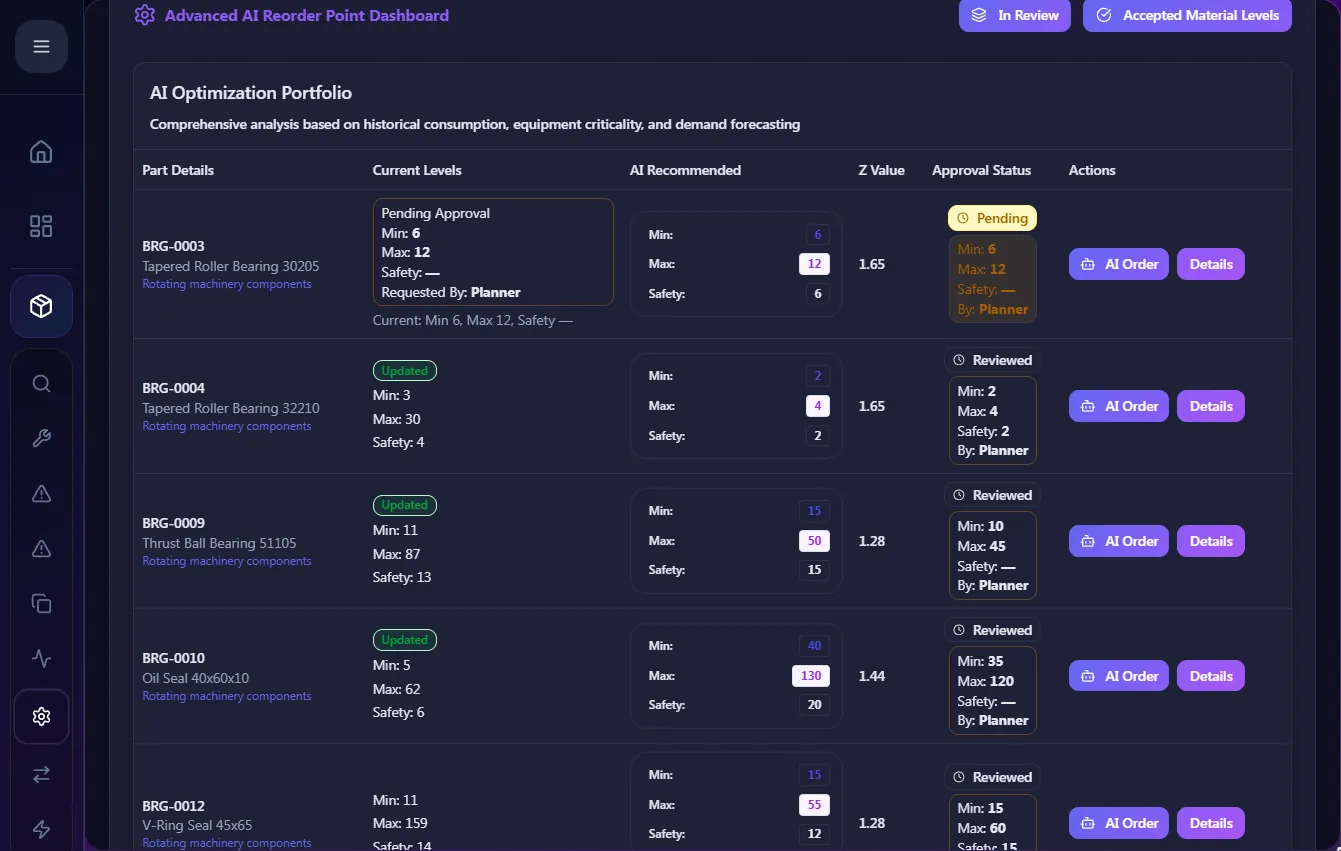
Get a free diagnosticEvery reorder point is recalculated from criticality, forecast demand, supplier reliability, lead time, service level and stock at other sites. You see current and recommended levels side by side, with the investment implied.
Raise BRG-0003 levels: min 2 → 4, max 6 → 9
Criticality 8.25, 21-day lead time, supplier on time 78% of the time. Inventory investment implied: +$1,240.
Approved. Written to SAPPlaced a PO for 12 × V-belts, $1,840
Below the reorder point and under your $5,000 autonomous limit.
Ordered within your limitMin, max and safety stock are set once and rarely revisited, while lead times, criticality and demand move on.
Every recommendation shows the criticality, lead time and forecast behind it, and the inventory investment it implies.
For each part: current min, max and safety stock, the AI recommendation, the service-level factor used and the approval status. Open any part to see the forecast, installed base and open POs behind the number.

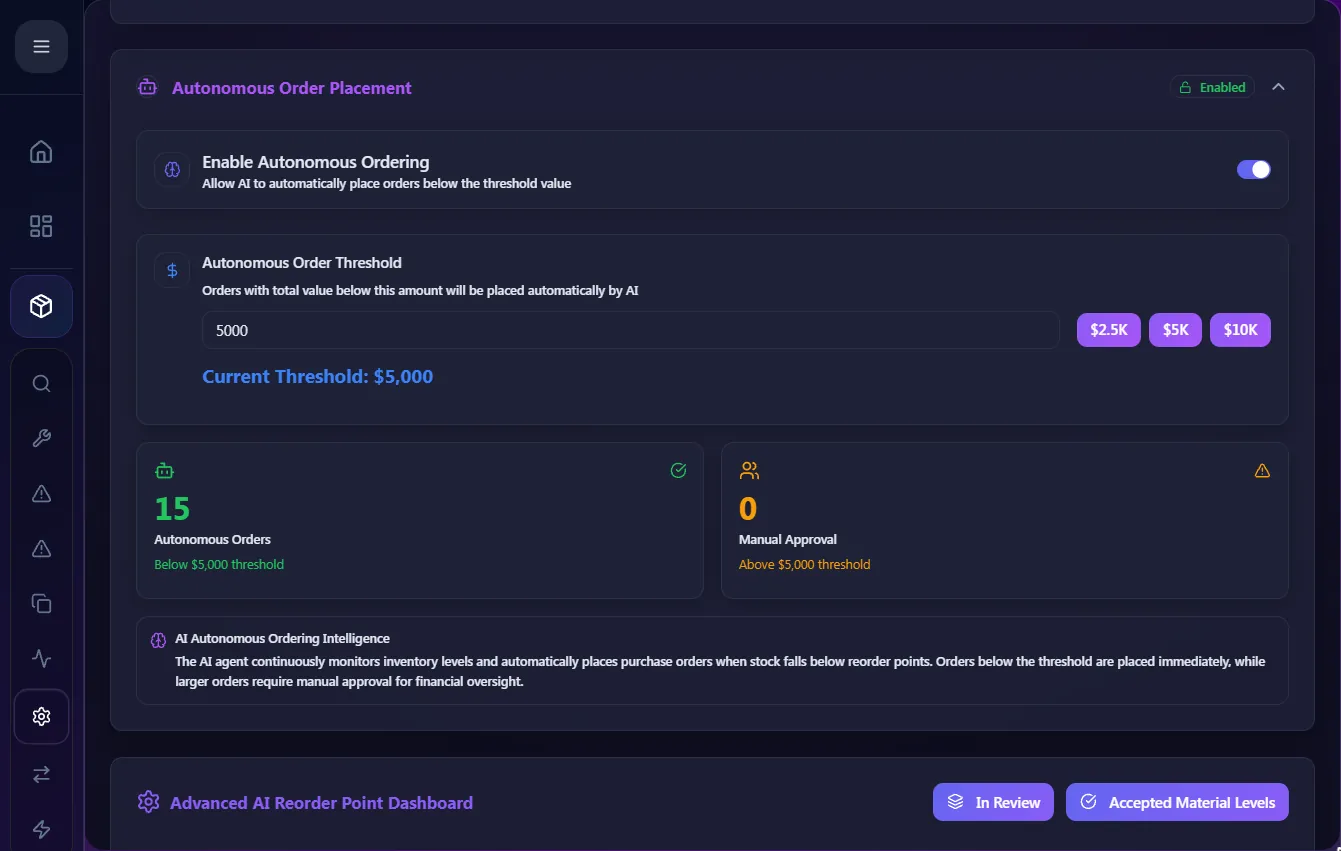
Switch on autonomous ordering and set a value threshold. Below it, the AI agent places replenishment orders when stock falls below the reorder point. Above it, orders wait for manual approval.

Autonomous ordering is off until you turn it on, and it only acts below your value threshold. Everything else needs a named approver.
Reorder agentRaise BRG-0003 levels: min 2 → 4, max 6 → 9
Criticality, demand forecasts and stock velocity meet real lead times on one review board. Every recommendation ends in one of three actions.
What feeds it
Spare Part CriticalityHow much protection each part deservesDemand ForecastingHow much will be used, by order typeStock VelocityHow fast each part actually movesCurrent and recommended levels side by side, each with its reason and the investment it implies.
What it leads to
Approved levels also keep planned jobs covered in Work Orders Planner and Vendor Intelligence.
Only after approval. Recommended levels sit in review until an approver accepts them; then they are written to the ERP.
When a part falls below its reorder point and the order value is under the threshold you set, the AI agent places the order. Larger orders go to the approval desk. You can switch it off.
Yes, including manual reorder-point and standard MRP types, where SAP never recalculates safety stock.
Send material master, movements and purchase history. We recalculate min, max and safety stock for every SKU and show where today's settings are too high or too low.
Free diagnostic. Findings within days.
A short call with an MRO specialist. We'll also email a secure link for your extract.
Free guide · 16 pages · PDF
Where MRO money leaks, how nine AI agents close the gaps above the ERP you already run, and what operators have measured.
We use your details to send the guide and related MRO360 information. See our privacy policy.
Oil and Gas organizations face huge unwanted costs in the form of losses, penalties and compensation due to industrial accidents, taking a sizable chunk of their revenues. One of the important reasons for failures and accidents is the breakdown of key industrial infrastructure arising from ineffective management of the material base and inefficiencies in the MRO supply chain that are highly critical for the production and maintenance cycles.
More and more organizations are now looking to establish Master Data Management (MDM) implementations in order to manage their assets through informed decision-making based on reliable data and ensure optimal industrial safety across the enterprise.
About the company:
This US based company is a global leader in providing essential mechanical components for both land and offshore drilling rigs, complete drilling and well servicing rigs, as well as a comprehensive range of tubular inspection, internal coatings, drill string equipment, lifting and handling gear, and downhole drilling tools. It also offers supply chain services through distribution centers strategically located near major drilling and production sites worldwide. With over 800 manufacturing, sales, and service centers globally and annual revenues exceeding $12 billion, the company delivers customer-focused solutions tailored to meet the energy industry’s quality, productivity, and environmental needs.
The company faced significant challenges with their master data.
• Lack of consistency and standards for the master data
• Incorrect, incomplete, unclassified and outdated attribute fields of master
data High volumes of data in multiple languages
• Multiple ERP and other legacy instances across the company
• Poorly structured material descriptions
• Lack of data governance and collaboration across cross-functional divisions and locations
Solution: Material Master Data Harmonization & Ongoing Maintenance
The company implemented Verdantis Material Harmonize to cleanse and enrich its historical material master data. Using AI-powered tools and the Verdantis Content Repository, the solution classified, standardized, and eliminated duplicate materials.
Once the data was harmonized, Verdantis Material Integrity was deployed for ongoing data governance. It ensured continuous data accuracy through real-time validation, AI-driven classification, and duplication prevention, maintaining high data quality across enterprise systems.
Key Actions Taken:
Results Achieved:
By integrating Material Harmonize & Material Integrity, the company achieved a scalable, AI-powered Master Data Management framework, ensuring long-term data consistency, efficiency, and compliance.